


Calling all mediums, witches, and misfit teenagers! It’s time to light your candles and grab your Ouija boards, ‘cause we’re gonna have a seance and summon the Ancient Order of Arachnids:
That’s right, my magical friends, this week’s creepy crawly article is about those spindly eight-legged critters also known as Harvestmen or Harvesters. They’re of the order Opiliones, an ancient order indeed, with fossils dating back over 400 million years. Even though they’re easily mistaken for spiders, Daddy Longlegs are not even closely related! Sure, they have eight legs and a set of pedipalps, but that seems to be where the similarities end. Let’s make some quick comparisons, shall we?
Body:
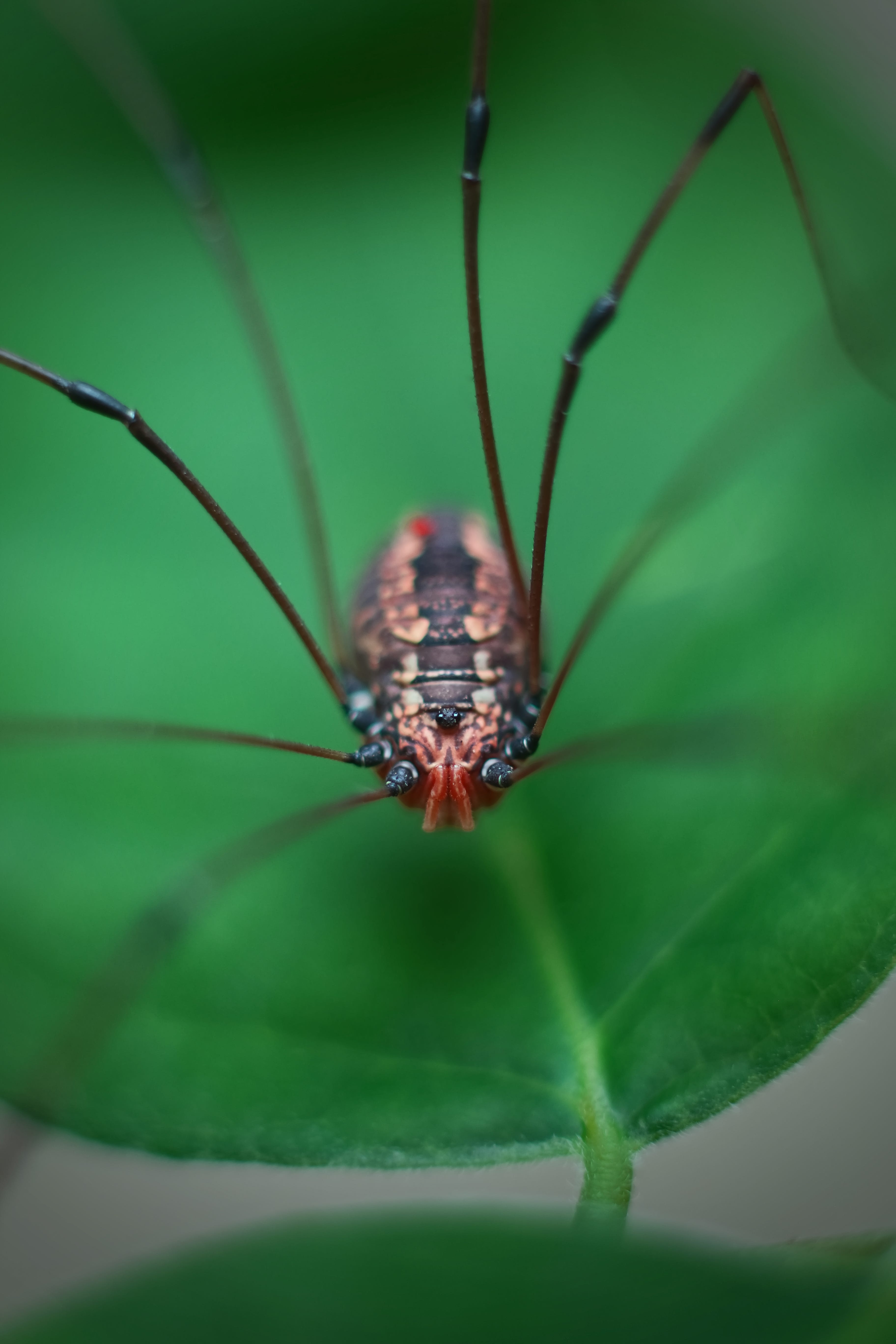
Unlike spiders whose cephalothorax and abdomen segments are attached with a ‘pedicel’, giving them a sort of hourglass figure, Daddy Longlegs’ segments are connected across the width of the two parts, making them appear as one single ‘piece’. And you know what? Both shapes look great in a Ritual Cloak, so no body shaming here.
Eyes:
We pretty much all know that most spiders have many eyes (generally 6 to 8 of them) located in clusters around the front and sides of the cephalothorax. Daddy Longlegs? They’ve got just two, which sit right on top of the cephalothorax (it reminds me of the location of the bridge on the Enterprise, but maybe that’s just the Trekkie in me talking). Not only that, Harvestmen eyes are much simpler than those of spiders. spider eyes are quite complex, capable of forming detailed images and evaluating distance. Daddy Longlegs’ eyes are essentially light and dark sensors, allowing the Opiliones to detect movement.
Webs:
All spiders can spin silk, and many make webs. Harvesters can’t and don’t. The long-legged arachnids that live in those messy webs in your basement or garage? Those are actual spiders called Cellar Spiders, not the Daddy Longlegs, so blame the right critter when you accidentally walk into one and panic-flail, knocking the rake off its hook then stepping on it and smacking yourself in the face with its handle, mmkay?
Diet and Digestion:
Spiders are by and large carnivorous, meaning they only eat other animals. Opiliones on the other hand, seem to be mostly omnivorous: they eat animals, plants, and fungi. The way Daddy Longlegs eat also differs from spiders. Spiders need to liquify prey with enzymes in their venom in order to eat (I will go into detail on this when I inevitably write a spider article). Harvesters actually use mouthparts called chelicerae to tear their food into little chunks which they consume and digest internally.
Speaking of Venom:
You ever hear that Daddy Longlegs are actually the most venomous animals in the world, but their ‘fangs’ are too small to penetrate our skin? Well, that’s half true; our gangly friends cannot penetrate our skin. As for venom? Let’s ask the Ouija board…
Alright, it’s established: Daddy Longlegs ≠ Spiders.
Now, my spooky summoners…I don’t want to freak you out…but did you notice that when we called upon the Ancient Order of Arachnids, our Harvester specimen arrived with a buddy?
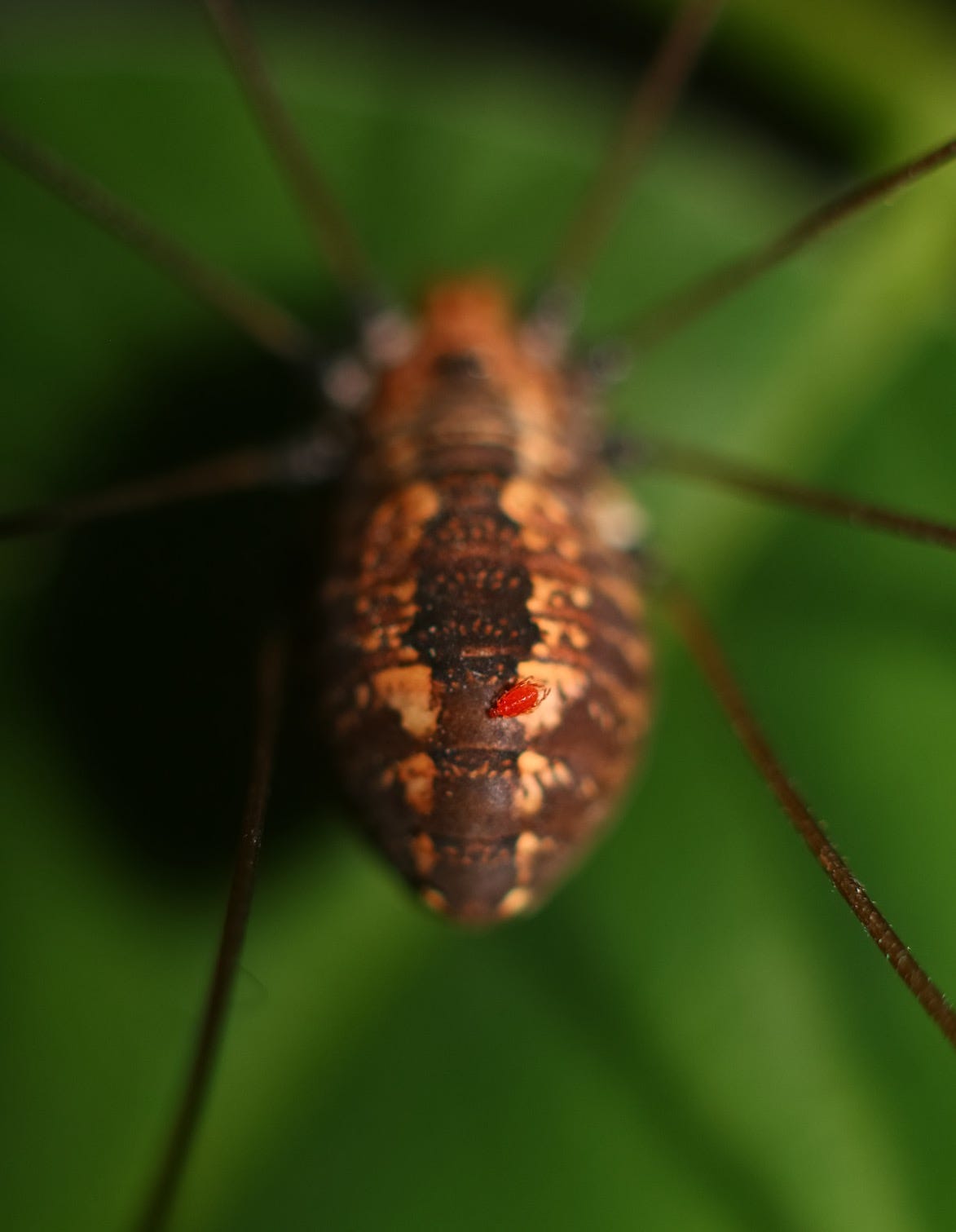
What the hell is that?? A teeny tiny demon on the Daddy Longlegs’ back, sucking out its soul like a Succubus? I mean, yeah, kind of. This little one is a larval Leptus, a type of mite, and it’s feeding on this Harvester’s hemolymph, which is the arachnid version of blood. So, maybe more of an itsy bitsy vampire?
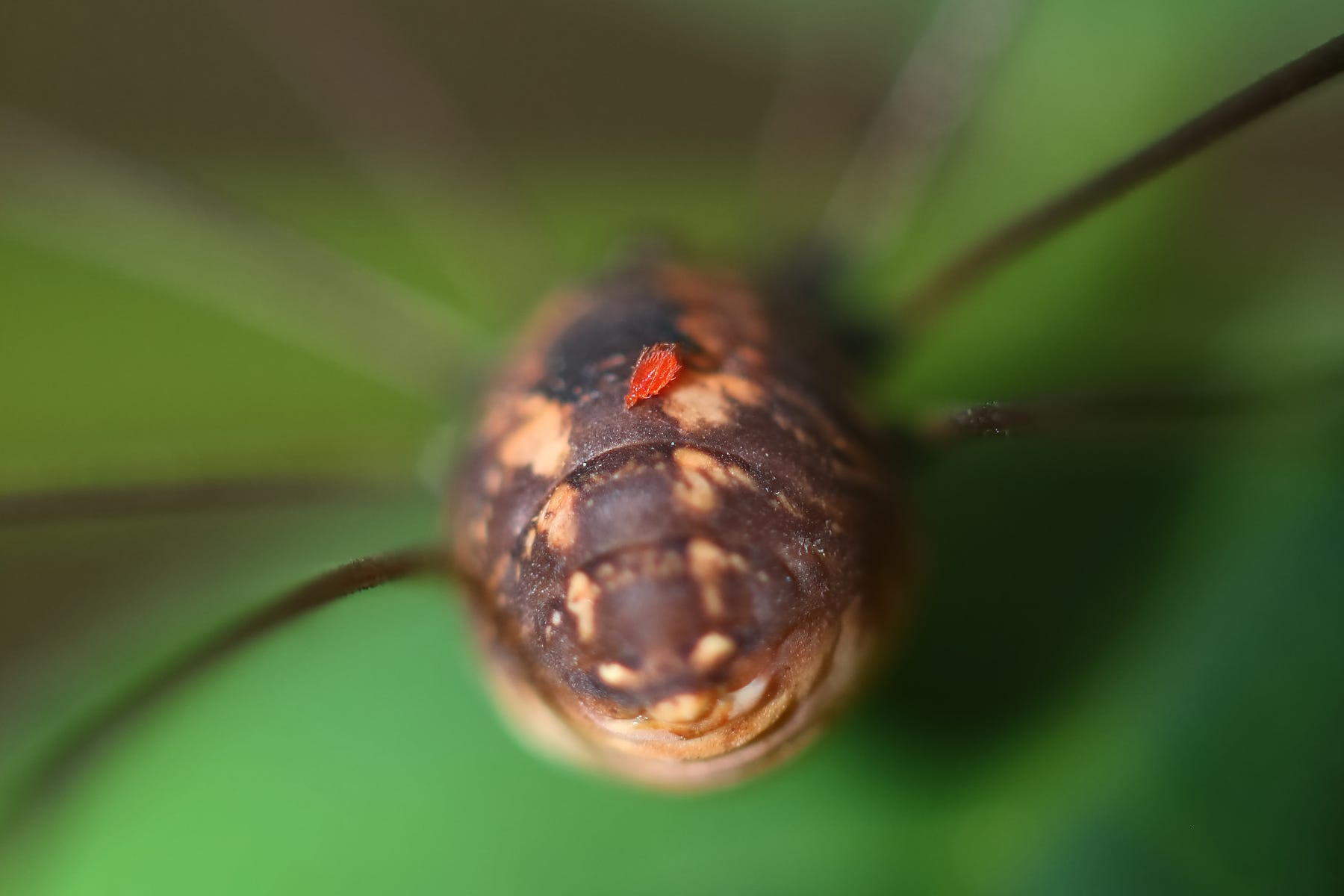
The good news is that Leptus (Lepti? Nah.) are only parasitic in the larval stage, and generally don’t really do any lasting harm to their hosts, unless there are a ton of them on one body, taking more hemolymph than the host can ‘spare’. They access the hemolymph by piercing the cuticle and then sucking out that delicious arachnid life-force with their stylostome - basically a built-in drinking straw. When it’s time to molt into the nymph stage (then ultimately the adult stage), the Leptus larva simply falls off with nary a thank you. So rude. So goth.
These Leptus larvae are also witness to something I didn’t anticipate covering in this article: Daddy Longlegs Sex. Now’s a good time to place your NSFW-protection charms because I’m about to get explicit up in this coven.
While some Opiliones can reproduce asexually, they also mate with the opposite sex for reproductive purposes. But it’s a bit more…nuanced…than just finding a mate and doing what’s mechanically necessary to make more Daddy Longlegs. No, there’s gifts, there’s violence, there’s goddamn fellatio. The drama! It might as well be a soap opera: Legs of Our Lives, perhaps? Let’s break it down one thing at a time:
Gifts:
Male Harvesters offer up what’s known as a ‘nuptial gift’ in the form of a secretion from their mouthparts to entice the female. If she likes it, she is likely to engage in mating. He’s pretty forward about it, rubbing his penis on the female’s mouth, then inserting into her genital opening. If she doesn’t go for it, well…
Violence:
Males get pretty offended if a female isn’t interested and may then aggressively bite the female’s legs and body, sometimes to the point of fractures and death. That’s some real Incel behavior, guys. So what’s a lady Daddy to do? Well…
Fellatio:
Apparently about 44% of females in one study licked the interested male’s penis, resulting in shortened copulation time, or avoiding mating (and violence) altogether. Scientists speculate that this is a purposeful tactic to, “minimize sexual encounters.” No means no fellas, yeesh.
I refuse to end this article on blow job facts, so before we close the portal to the Ancient Order of Arachnids, we’ll finish (heh) with this: Daddy Longlegs got rhythm, baby!
Part of a Harvester’s defenses is what’s referred to as ‘bobbing,’ and it looks like it sounds. An individual, or in flash mob style, a group of Daddy Longlegs will bob or vibrate their bodies to confuse predators, and depending on who you are, it’s either peak silliness or peak nightmare fuel. You decide:
Now, back to the Ancient Realm with you!
I found this article wildly entertaining actually- thank you!
Now why am I not surprised you're also a Trekkie? And a follow-up question... in the UK, what they refer to as "daddy longlegs" are clearly just cellar spiders or similar. Are actual daddy longlegs only native to the Americas?