


It’s October! Spooky Season! Halloween Month! Time for horror movies and pumpkin carving! Time for dabbling in witchcraft and summoning demons! (Too far?) Best of all, it’s time for The Clearing to embrace the creepy crawlies, drop some spooky science and maybe even bring some of you around to the value ‘scary’ creatures have in the world.
I've decided to kick things off with a critter many of us may not be necessarily scared of, but commonly view with disgust…
Houseflies! (Cue maniacal laughter)
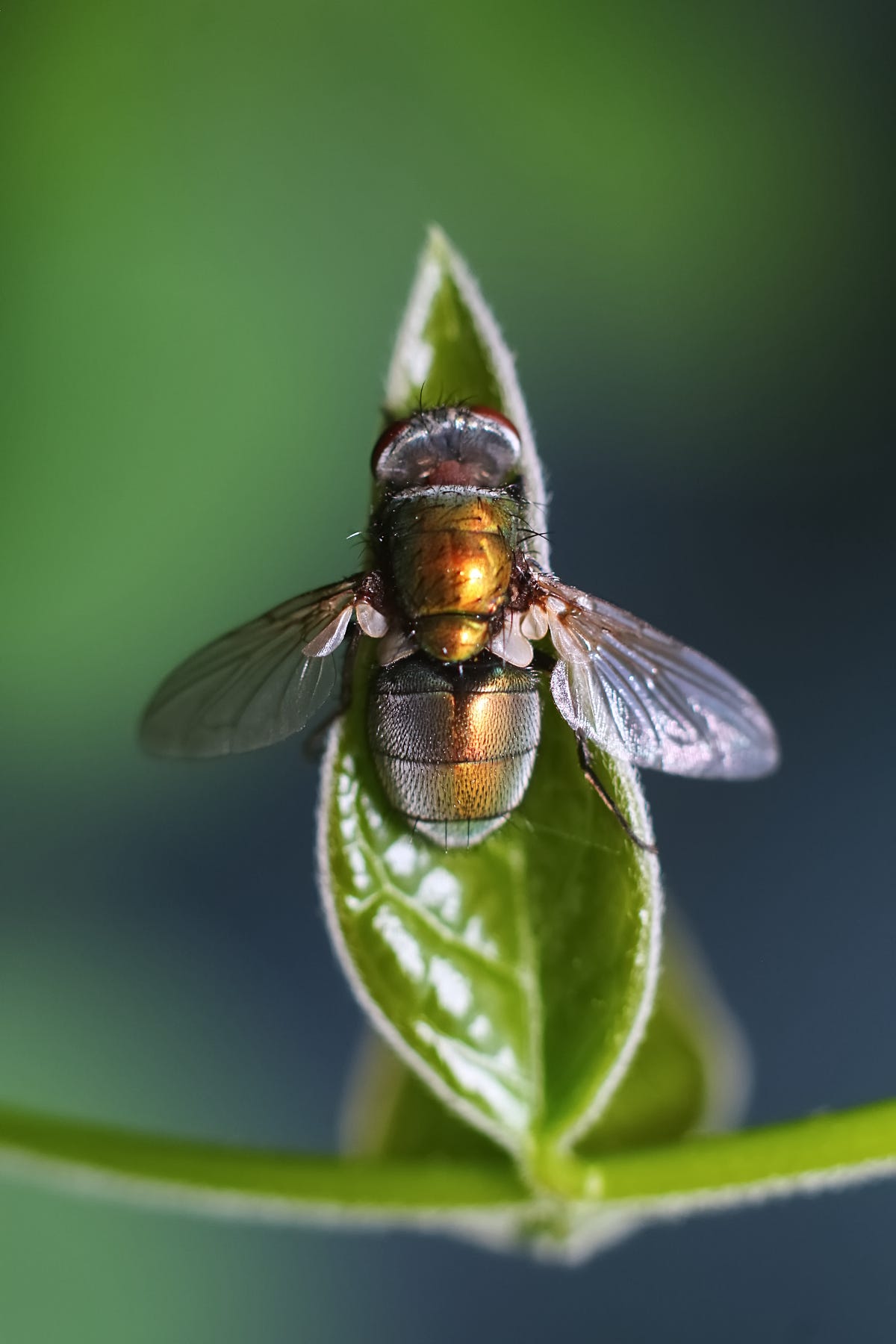
Look, I get it. Flies (for the duration of this article, ‘flies’ means houseflies - Musca domestica specifically) can be obnoxious and gross. They buzzzzzzz in our windows, land on our food, and when there’s a lot of them around, it usually means something disgusting is nearby. Honestly, many of our common conceptions of flies are pretty accurate. They’re vectors for bacteria and disease. They like yucky things, land on and eat them, then spread that shit (often literal shit) wherever they go next. I’m not even here to make a case for liking flies, though as a biocentrist I will wrap this article with some positives about them, dammit.
Really, I’m here to share some lesser-known Halloween-y facts about flies!
For one, I learned that female flies seem to be grosser than males in terms of their bacterial abundance. They make and lay eggs and therefore seek more protein-rich sources which translates to more ‘eww’ sources like weeping wounds, mucous and other *shudder* secretions. Females carry another…ahem…load with them in the form of sperm from the (usually) singular time they mate in order to fertilize more than one batch of eggs. They lay those eggs on carcasses (carrion), feces, and decaying food, availing them to more bacteria. Delicious.
And yeah, there’s justified cause for concern over the ‘dirtiness’ of flies. They can spread disease quite readily by picking up a pathogen from a waste source and spreading it to a food source, for instance. They’ve also been shown to contribute to antimicrobial resistance by (I’m putting this in extremely simplified terms) feeding on, say, antibiotic-treated livestock then spreading antibiotic resistant microbes to other environments. Not cool, flies.
But there’s also a very human-centric benefit to the fly’s propensity for collecting Ick, and that’s forensics.
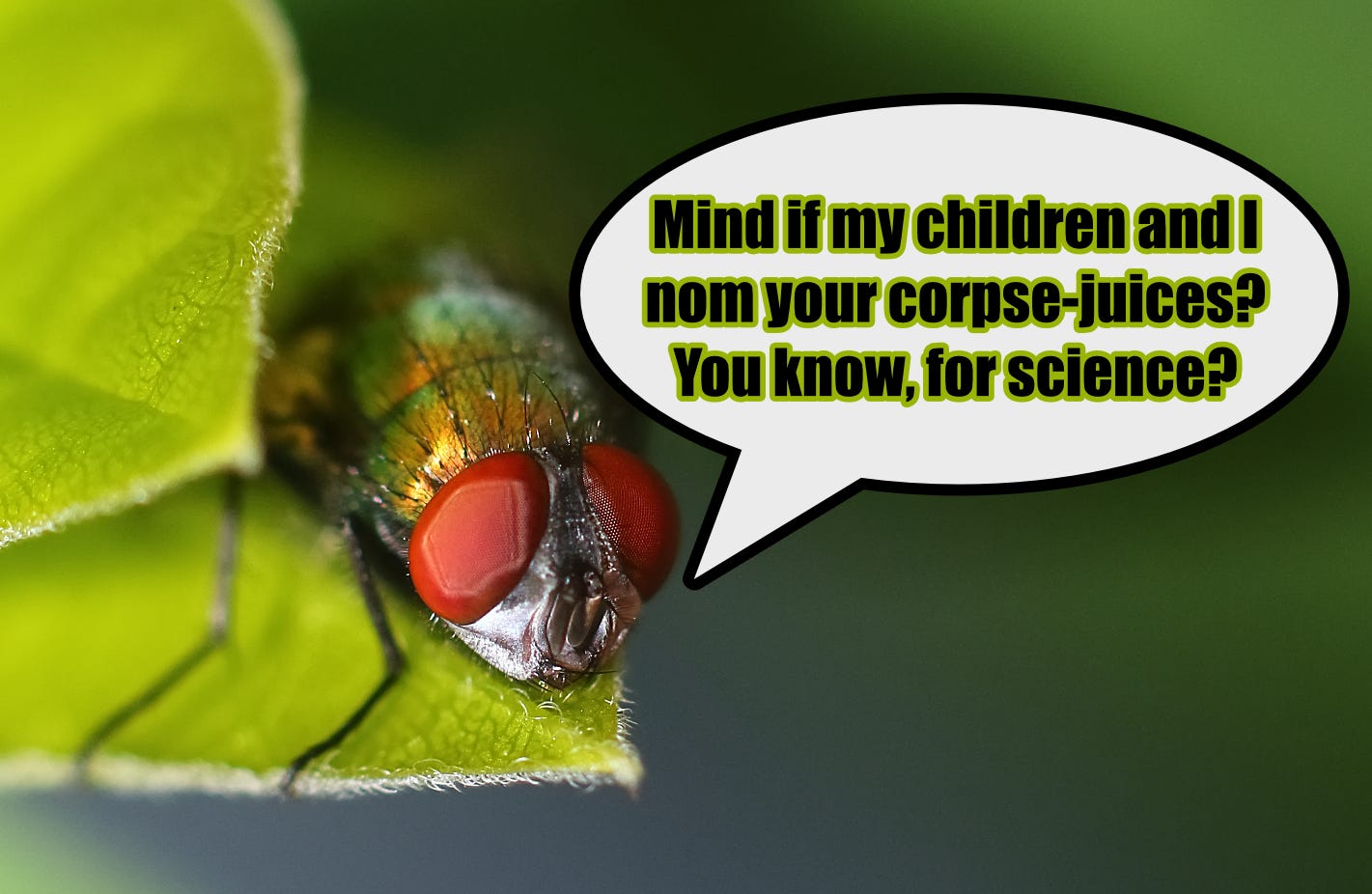
The presence and correct analysis of flies in all life stages can help to determine things like the timeline for post mortem decay and even provide clues as to the likelihood of the neglect or abuse of a victim prior to their death (think the presence and age of flies/eggs/larvae in unattended wounds and the like). Another forensic use stood out to me as especially interesting in the case of drug-related crime scenes, namely the actual identification of such substance(s) in a decayed body by analyzing the larvae that fed on the corpse. Morbid and disgusting, but, you know…useful and science-y!
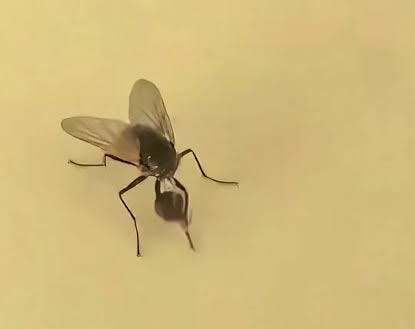
Okay, let’s get even more chilling. Some of you may have seen a viral video of a fly that apparently popped its own head off while grooming. I just hate when that happens, don’t you? The fly’s body appears unbothered by the loss of this apparently not-critical-to-living structure, continuing its grooming motions with its head rolling around between its tarsi. When I heard about it I was sure a huge chunk of my article would be about this phenomenon, but I couldn’t find any scientific sources verifying or explaining what happens. The video appears real but also doesn’t show the actual decapitation.
The claim is that sometimes flies get so vigorous in their grooming that they accidentally detach their goddamn noggin, which is only holding on by a thin membrane of chitin (if you recall my Zap story, that’s the same stuff that makes up butterfly wings). Any outright verification of the claim is in the form of Reddit comments or TikTok reactions, which, say it with me, are not scientific sources. I tried to find sources that could at least explain the reasons a fly’s body still functions for a time after decapitation, but those are also lacking, so I’m not going to speak on any of that and simply say, how spooOoOooOky!
Finally, I present to you the star of this article: ZOMBIE FLY FUNGUS!!!! AHHH!!!!
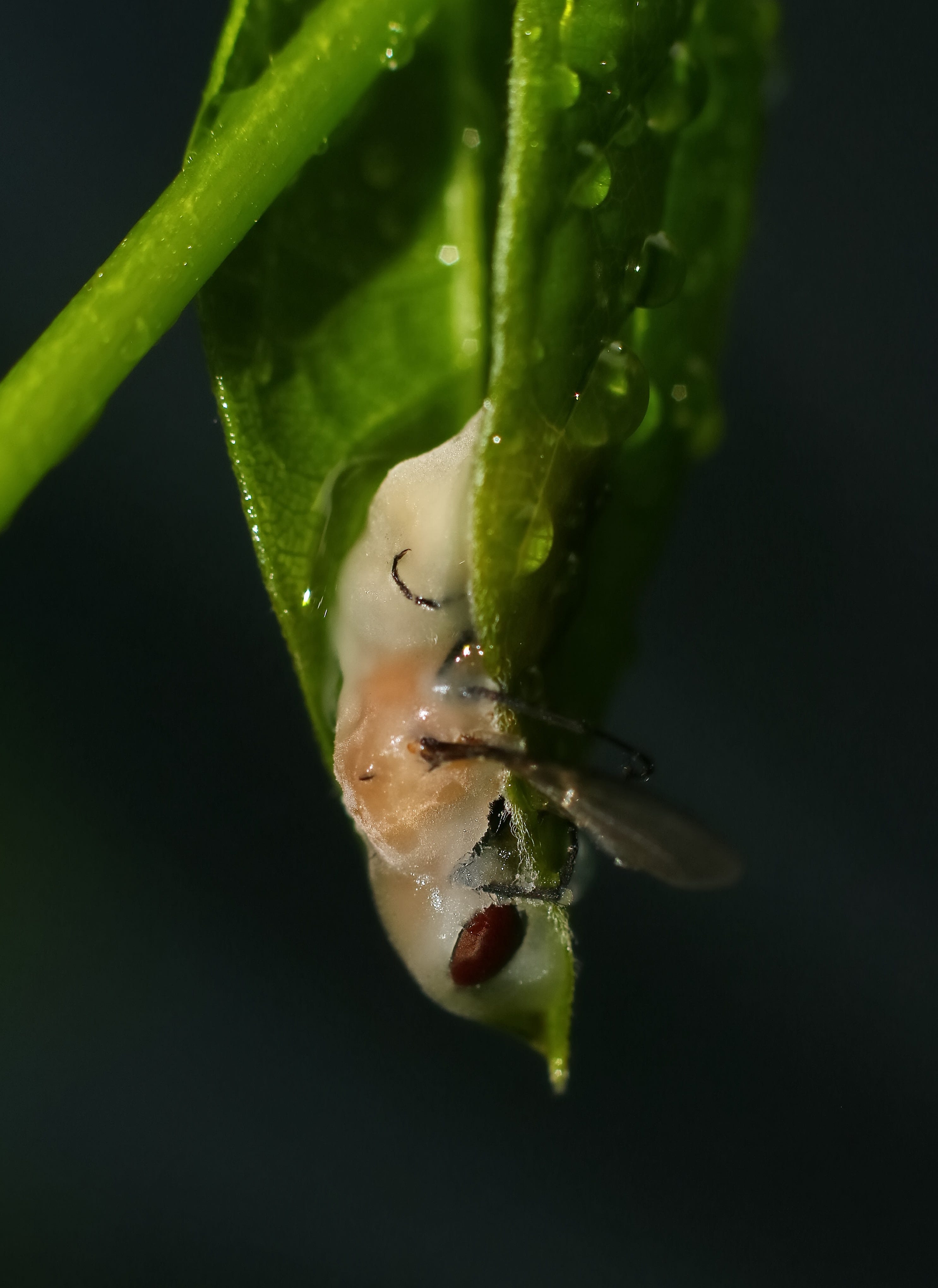
Ever see a dead fly stuck to the tip of a plant’s leaf? I have come across enough of them question why and do some digging. I thought, hey, maybe flies can sense when they are dying and pick a nice lookout point on a leaf to enjoy the view one last time. Or perhaps the leaf excretes something sticky that keeps the fly stuck to the spot until it expires. Nope, the answer was much more sinister and not at all what I expected: a pathogenic fungus called Entomophthora muscae.
In simple terms, spores from this fungus land on the fly, penetrate its body and enter the circulatory fluid (called hemolymph). The fungus is then able to grow throughout the fly, digesting its guts, and killing it in about 7 days - seems like a long time to be eaten alive by a fungus, but maybe that’s just me. During the process, the fungus can also penetrate the behavioral center of the brain essentially creating a Zombie Fly a la The Last of Us, forcing the fly to land on a surface like a plant and crawl to a high point. Finally the fly (really the fungus in a fly costume - Trick-or-Treat!) glues its frickin’ mouthparts to the surface, spreads out its wings, and dies.
At sunset.
Like, the death always happens at sunset. The hypothesis is that it’s darker and cooler at that time, making for better spore-releasing conditions. Hey, maybe I was right about enjoying the view one last time…
So, with Zombie Fly’s mouth glued (like, why??) and wings spread at the tip of a high point, spores emerge from the intersegmental membranes (the flexible spots of the segmented body) and eject from the surface, falling to whatever lucky bastard sits below to start the cycle over. I bet you’re singing The Circle of Life right now, huh? So beautiful….
The Entomophthora muscae fungus has been investigated as a biological pest control agent, where it would basically be purposely introduced via human intervention to ‘pest’ populations as a method to reduce said pests’ numbers. While I understand the need for insect control in agriculture, and don’t hate that it isn’t a chemical agent, the idea of unleashing a pathogen that slowly eats its host from the inside makes my tummy hurt. Unfortunately (fortunately?) the fungus is pretty easily inhibited by high air temperatures and is difficult to store, so is not used as a commercial pesticide.
Alright let’s wrap this up with a list of positives about houseflies, shall we?
They’re pollinators! Albeit, inefficient ones. Flies are less hairy and so less pollen sticks to them, but they still get some of that job done and the more pollinators the better, right?
Their repulsive little maggot-babies are GREAT at breaking down organic material, essentially recycling feces, carrion and the like into nutrients for the soil, and feeding the plants (start singin’ that song again!)
They’re food! Flies and fly larvae make for great sources of protein for many birds, lizards, spiders, and even fish. And we like all of those animals, right? Right?? And friends, let’s not forget the Venus flytrap and other carnivorous plants - nature is so weird and cool.
So join me in saying, thank you, flies. Also, stay off my plate, mmkay?